

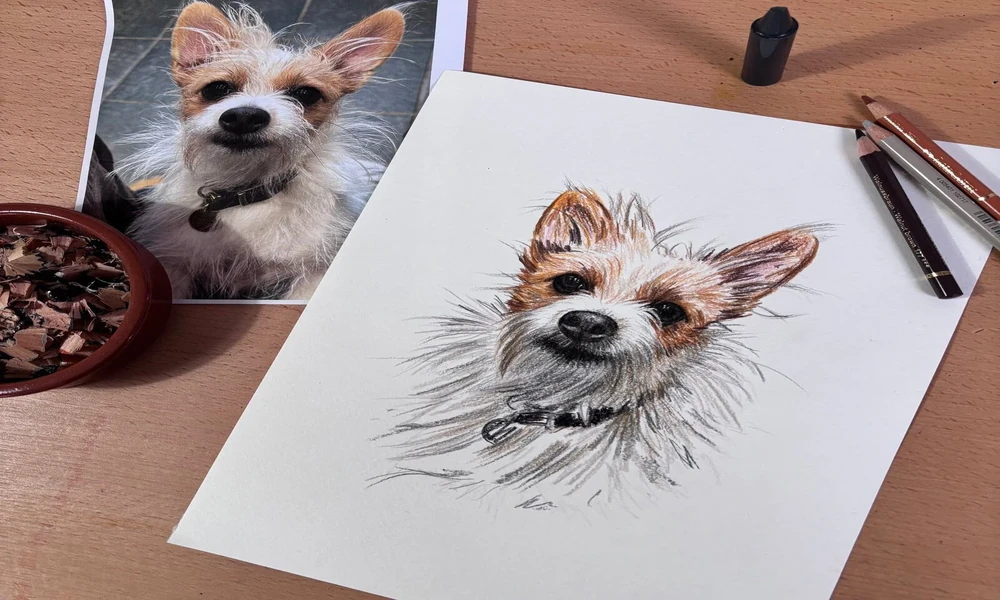
Sometimes the photograph you want to keep looking at is not the clearest one you own. It may capture a familiar expression in a dim room, show your pet in the distance, or survive only as a small copy someone sent years ago. Its importance to you does not depend on how much detail it contains.
Planning a portrait from that image starts with two separate questions: what makes the photograph meaningful, and what information can it actually provide? Keeping those questions separate lets you explore the possibilities without asking a maker to guess at details neither of you can see.
Describe the limitation before trying to fix it
Open the best copy you currently have and make a simple observation note. Avoid judging it only as “bad quality.” Say what is difficult to see and what remains clear.
Perhaps the outline of the head is visible but the eyes are indistinct. Perhaps the expression is readable but a shadow covers one cheek. Or the pet’s face may occupy such a small part of the picture that you cannot confidently identify a marking.
Distinguish missing views from unclear views. A blurry front paw and a paw entirely outside the photograph are not the same problem. Neither should quietly become an invitation to invent a detail.
Next, write what you value about the image. “I want this head tilt” is different from “I want every detail of this scene.” You may be willing to use a second photograph for the portrait if it preserves the feature you actually care about.
Keep your observations modest. You are describing what you can see, not diagnosing a technical fault or determining whether the file will work for a particular product. That final question belongs with the selected maker and design.
Look for the source before making a new version
Before applying changes, trace where the photograph came from. Was it taken on your phone? Shared by a family member? Downloaded from a social post? Scanned from a print? The answer gives you a practical place to look next.
Check whether the original file still exists in a photo library, on the original device, or with the person who took it. Ask for the image file itself rather than another screenshot of a message containing it. If several copies exist, keep them labeled so you know which is which.
For a photograph that exists only as a physical print, tell the maker that you have the print and ask what kind of copy they can assess. Do not assume that the first phone picture you take of it is the only available route.
Preserve the version you started with. If you try an edited copy, keep it separate and describe what you changed. An image that looks smoother or sharper to you may still leave the original uncertainty unresolved. Avoid treating newly visible detail as confirmed unless you can check it against a reliable reference.
Set a sensible stopping point. If you have checked the likely sources and found nothing clearer, the next step is an honest assessment of the existing material, not an endless search for a perfect file.
Make filenames useful during that search. Labels such as “original from camera,” “copy from message,” and “edited planning version” record where each image came from without declaring one suitable for production. Keep a note if the person supplying a file is unsure of its origin. When you later ask for an assessment, this small record helps you explain which version is the source and which ones have been changed.
Give every supporting photograph a specific purpose
Additional images are most helpful when you explain what each one contributes. Sending twelve pictures with “use whichever” leaves the central preference unclear.
Create a small reference inventory. For each image, record a filename, the detail it shows, and anything that makes it a limited reference. Here is a hypothetical example:
- Window photo: The preferred head angle and expression; one side of the face is in shadow.
- Garden photo: A clear view of the cheek marking; the mouth is open, unlike the preferred image.
- Older close-up: A useful view of the eyes; taken before the appearance shown in the main photograph.
The inventory does not instruct the maker to combine every feature. It explains why each image is present and where judgment is still needed.
Be particularly clear about changes over time. If the photographs show different grooming, markings that look different in the available images, or different life stages, identify the appearance you want represented. Do not leave the maker to choose a period from the file order.
Include an “unknown” line. You might write, “None of these photographs clearly shows the end of the left ear.” That statement protects the brief from becoming more certain than the references allow.
When planning pet portraits from photos, a small, explained set is easier to discuss than a large collection whose images seem to contradict one another.
Ask about a particular portrait, not a general rescue
Read the selected provider’s pet photo requirements before deciding how to submit your files. If your best image falls short of the examples, explain the limitation rather than trying to hide it with an edited copy.
Then identify the actual product or design you are considering. “Can this image be used for this portrait?” gives the maker a clearer starting point than “Can you fix my photo?” The second question could imply an entirely different service.
If you are exploring Pawfolio Art’s custom portraits, choose the design you are interested in and keep your inquiry connected to it. Ask how to have an uncertain reference assessed through the available contact process; do not assume that every image or requested change can be accommodated.
Explain which compromise you might accept. Perhaps another photograph could supply the main view, or a different composition would avoid an unseen area. Equally, name the detail on which you are unwilling to compromise.
Ask what remains uncertain before placing the order. A useful response should help you decide whether the proposed custom pet portrait fits your expectations. An attractive example elsewhere on the site cannot answer a question about information missing from your particular photograph.
Keep several possible outcomes open
After an assessment, you may be ready to proceed with the original image. You may choose a different reference, adjust the scope of the portrait, or decide that a commission is not the right next step.
None of those choices reduces the value of the photograph. You can preserve a favorite image as it is without turning it into a personalized pet portrait. You can also keep the image for its memory and select a clearer, less emotionally significant photograph for the artwork.
If you proceed, save the agreed reference set and the explanation of what each file establishes. That keeps the starting point clear if questions arise later. Avoid substituting a newly edited version without explaining the change.
If you postpone, keep the files together with your notes. You will have a useful record should a better copy turn up or another portrait approach become appropriate. There is no need to invent a deadline for a decision that still feels uncertain.
Send a question the reference can support
A concise inquiry could be: “This is my preferred expression, but the eyes are unclear. The second photograph shows them more clearly. Can these references support the selected design, and what details would remain uncertain?”
That question gives the maker useful information without promising a result in advance. The goal is not to make a treasured photograph pass an arbitrary test. It is to decide, honestly and specifically, whether the available references can support the portrait you want.